
- [C] Steven A. Cerra, copyright protected; all rights reserved.
He’s a communicator in the Peterson manner, voicing melodies in a recognizable yet inventive way, adding just enough rhythmic nuance to take an interpretation out of the ordinary, and placing absolute trust in his rhythm section sidemen ….”
- Richard Cook & Brian Morton, The Penguin Guide to Jazz, 6th Edition.
"David Hazeltine is for sure the brightest star on the jazz piano horizon. His style has a deep-seated commitment to jazz history while communicating a wealth of 'today's' ideas..." - Cedar Walton
“He’s always made the music better. … He doesn’t try to over complicate things. His voicings are beautiful, his comping is rhythmic and he’s at home in a lot of styles.”
– Jon Faddis
The piano, bass and drums trio is a form of Jazz expression that has been constantly pleasing to me over the years and among its current practitioners, I find myself returning again and again to the music of David Hazeltine.
David Hazeltine is a pianist, composer, arranger whose creative talent has received well-deserved praise from the Jazz press in recent years.
He has been the subject of a recent article in down beat magazine as penned by the distinguished Ira Gitler and there are also two, comprehensive treatments about him and his work on the All About Jazz website, one by John Dworkin and the other by Bruce Crowther which is available below and which forms the conclusion of Part 1 of this feature.
In addition to his trio work, Mr. Hazeltine plays in the groups led by trumpeter Jon Faddis and alto sax and flute player James Moody, and he is the artistic/musical director for vocalist Marlena Shaw and the collective One for All.
The JazzProfiles editorial staff became familiar with Mr. Hazeltine’s playing primarily through three different, yet convergent, sources: [1] his own piano, bass & drums trio albums,[2] his work as the pianist and one of the composer-arranger for the sextet known as One for All, and [3] his appearance as a pianist on the albums by each of the principal horn players who make up One for All – trumpeter Jim Rotondi, trombonist Steve Davis, and tenor saxophonist, Eric Alexander.
For a group of musicians who individually and collectively have been on the current Jazz scene for less than 15 years, they have issued an astonishingly large number of excellent recordings, many of which will be reviewed and discussed in Part 2 of this feature.
This “abondanza” not only speaks to the quality of their musicianship but also to the artistic and entrepreneurial foresight of Gerry Teekens at Criss Cross, Marc Edelman at Sharp Nine and Tetsuo Hara and Todd Barkan at Venus Records, the owners of the three labels that have taken a principal interest in recording them.
In an effort to do justice to the full spectrum of his work, the first portion of this JazzProfiles feature on Mr. Hazeltine will focus on his trio recordings while Part 2 will highlight his work on recordings by One for All and his playing as a pianist on the albums by each of the principal horn players who make up One for All such as trumpeter Jim Rotondi, trombonist Steve Davis and tenor saxophonist Eric Alexander.
[Caveat: This feature begins with a discussion of Mr. Hazeltine’s most recent trio recordings, three of which appear on Venus Records, a Japanese label that is solely owned by Mr. Tetsuo Hara. It would appear that Mr. Hara has a penchant for risqué and revealing cover art on his CD’s, some of which might be judged inappropriate. However, the editorial staff at JazzProfiles did not see that it was within its purview to censor this artwork in any way.]
Mr. Hazeltine has issued over 25 album under his own name and most are gems of piano trio Jazz that offer stylistically interesting arrangements and inventive, emotionally engaging soloing.Another element of Mr. Hazeltine’s approach to Jazz that I find favor with is that he leaves plenty of room for his drummer-of choice, be he [usually] Joe Farnsworth or Billy Drummond or Louis Hayes, to stretch-out, which they all do in a melodically interesting way that is very reminiscent of Max Roach, one of the very few drummers whose musical solos were appreciated by nearly all listeners.
With his trio, Mr. Hazeltine has made theme albums that focus on the music of a single composer as well as albums that offer a more diverse repertoire made up of standards from the Great American Songbook, more recent composers such as Jimmy Webb and Stevie Wonder and his original compositions.As an example of the theme albums that focus on the music of a single composer, Mr. Hazeltine selected compositions by Burt Bacharach, and Bud Powell for two of his more recent recordings on Venus. A third issued earlier in 2003 was made up of compositions generally associated with, but not written by, the late Bill Evans.
Insuring that each tune is interestingly arranged, always trying to “say something” in his solos and sharing some degree of participation from his bassist and drummer in the expressive effort, these aspects of Mr. Hazeltine’s approach to trio Jazz are all throwbacks to trios headed up by the likes of Nat King Cole, Hampton Hawes, Oscar Peterson, Claude Williamson, Ahmad Jamal, Eddie Higgins, Red Garland, Vince Guaraldi, Victor Feldman, Hank Jones, Tommy Flanagan, Sonny Clark, Jimmy Rowles, Clare Fischer and, in more recent times, Keith Jarrett, Bill Evans, Alan Broadbent, and Michel Petrucciani, to list but a few.
What Mr. Hazeltine’s stresses in his approach goes to the essence of Jazz in that once a thematic topic has been engaged, it allows for a collective “conversation” involving his trio’s participants.
His idea of making Jazz is all about thoughtful and artfully presented music. There’s no technical grandstanding here, no flying fingers for the sake of flying fingers, but rather, a speculative inquiry along the lines of: how can I substitute interesting, alternative melodies and/or harmonies [appropriate chord substitutions] and fashion a different story to tell?
 This is no easy task considering the size of the footprint left on piano trio Jazz by many of its principal exponents over the years, not the least of which are those included in the previous groupings above.
How does a pianist take this tradition forward – by breaking the mould or by adding another layer to it?Here’s one way Mr. Hazeltine resolves this dilemma. Rather than attempt another fast and furious version of Bud Powell’s burner Tempus Fugit, he adapts it as a medium tempo cooker and, in so doing, clearly enunciates it’s melody as few before have ever done [including it’s originator]. He plays it through and improvises upon its AABA structure with a clarity that gives the original composition a pellucid quality rarely ever heard before. If you have ever wonder what this tune really sounded like while others have huffed-‘n-puffed their way through it in an effort to emulate Bud’s version, you are in for a treat when you hear Mr. Hazeltine’s interpretation of it.
And it doesn’t stop here, Wail which is usually played at tempos with an intent to snap off the metronome needle is also taken as a moderato as are Glass Enclosure and Dance of the Infidels, thus allowing the listener to get re-acquainted with their original melodies and their improvisational possibilities.
What we have here is not just a case of someone trying to be different for the sake of being different, but rather, a musician who is deeply interested in finding his own possibilities with Bud’s vehicles. The question becomes not one of emulating Bud Powell – a sheer impossibility – but of discovering David Hazeltine through the compositions of Bud Powell – a possible, artistic realization.
In his www.allaboutjazz.com interview with John Dworkin [October 3, 2005], Mr. Hazeltine commented about the Bud Powell project:
 Ken Dryden authored this laudatory assessment of the album for www.allmusic.com and he is absolutely spot-on in that Mr. Hazeltine’s interpretation of and playing on Bud Powell’s rarely heard Danceland is simply splendid as are the contributions of Mr. Mraz and Mr. Drummond on this tune:
 Another of Mr. Hazeltine’s recordings that concentrates exclusively on the works of one composer is Alfie: Burt Bacharach Song Book [Venus TKCV- 35375]. Besides delving into a songbook by a composer whose work is not usually associated with Jazz, here again uniqueness is a mainstay in the way Mr. Hazeltine configures each tune for interpretation and improvisation. The result is that he successfully brings Burt Bacharach’s music into the Jazz World and out of the commercial music triteness in which many of the composer’s tunes customarily reside.
On this CD, Mr. Hazeltine is ably assisted by bassist David Williams and drummer Joe Farnsworth as he refashions the title tune along with other familiar Bacharach themes into entertaining and interesting Jazz. He seems to have a knack for taking what are apparently commonplace and pedestrian melodies and bringing them to life as interesting compositions.
Whether its In Between the Heartaches played as an up-tempo bossa nova, or Close to You, rendered as a 6/8 Latin tune with the refrain played in a fast 4/4 that is wrapped around a bossa nova bridge, or This Guy’s in Love With Me played in a jaunty 2/4 before the soloing takes over in a snappy 4/4, and wait until you hear What the World Needs Now Is Love done in a finger popping, slow blues style.
The listener comes away from Mr. Hazeltine’s interpretations with an awareness of these and other new possibilities in Burt Bacharach’s music. It’s no longer schlock, but a assemblage of melodies that now warrants entry into the Great American Songbook.
 One of Mr. Hazeltine’s greatest gift is his ability to reinterpret the music of others so as to give it either a different and legitimate entry into the Jazz World, especially by making the music swing. He sees and hears other possibilities and brings the gift of freshness and imagination to his listeners.
And yet, in keeping with the tradition of other great Jazz trios, Mr. Hazeltine accords tremendous attention to detail in the arrangements that he brings to each tune. They are colored with interludes, vamps and other rhythmic phrases, new ways of segueing into the melody or closing out of it, and there are even thematic structures that are comparable to shout choruses before he takes certain tunes out.
And then there are the engaging improvisations; that draw the listener in and reveal different ways of putting notes together, phrases that sound familiar but really are unique, in spite of the stylistic similarities with Barry Harris and Cedar Walton. There’s nothing earth-shaking here, but Mr. Hazeltine swings like mad and as Jon Faddis emphasized in one of the opening quotations to this piece, “… he doesn’t over complicate things."
His music is so accessible and enjoyable that in addition to Barry Harris and Cedar Walton, the easy and effortless styles of Hank Jones and Tommy Flanagan come to mind when listening to Mr. Hazeltine.
Interestingly, as is the case on Alice in Wonderland [Venus TKCV 35327] he can take a collection of standards often association with Bill Evans, a pianist whose work is sometimes considered obtuse if not abstruse by some listeners, and make them utterly approachable and satisfying.
 Without attempting to sound demeaning of Bill Evans in any way, it’s almost as though Mr. Hazeltine has taken Bill’s lush voicings and taken them back through Barry Harris, Cedar Walton, Hank Jones and Tommy Flanagan, to subtract their essence and make them a bit less complicated and dense on the ear.
In his hands, these trademark Evans tunes tend. not to be as meanderingly introspective, but more concerted and concise. Once again in the company of George Mraz [b] and Billy Drummond [d], here is a quick snapshot of Mr. Hazeltine’s Alice in Wonderland album by Ken Dryden from www.allmusic.com:
While listening to the Mr. Hazeltine’s attempts at long, continuous "lines" [improvisations on Autumn Leaves [which has an excellent extended drum solo by Billy Drummond] and on How Deep is the Ocean, one is reminded to of pianist Lennie Tristano, who often aimed at lengthy, unbroken creations in his solos.
As the title of his disc Modern Standards [Sharp Nine Records CD 1032-2] would imply, Mr. Hazeltine broadens his interpretations of standards to include not only the more recent contributors to the Great American Song book such as Henry Mancini [Moment to Moment], Johnny Mandel [A Time for Love], Leonard Bernstein [Somewhere] and more of Burt Bacharach [A House is Not a Home], but to also reach out to arrange and improvise on tunes by The Beetles [Yesterday] and The Bee Gees [How Deep is Your Love]. The CD also includes Mr. Hazeltine’s very hip interpretation of Sy Coleman’s Witchcraft. Joining him on this recording and playing and integral and integrated part in its music are David Williams on bass and Joe Farnsworth on drums.

When asked in the John Dworkin www.allaboutjazz.com interview what about the music of these diverse composers “… seems to get to you,” Mr Hazeltine explained it this way:
“For many of today's jazz musicians, the wall between the Great American Songbook and modern pop has all but disappeared. Having been influenced by everything from the Beatles to Bartok, they've begun to make some of this music an integral part of the jazz repertoire. Pianist David Hazeltine emphasizes the point by calling his seventh Sharp Nine release Modern Standards. Putting aside his composer's pen for the moment, he focuses on songs of the '6os and '70s. One could fairly ask whether songs like these still qualify as modern. But it is Hazeltine's approach as a pianist and arranger that is modern. He's revealed it on previous recordings, with covers of songs by Stevie Wonder, Jimmy Webb and others. Modern Standards sheds sustained light on this area of Hazeltine's craft. It highlights a period when seismic shifts in popular music placed figures like Johnny Mandel, Burt Bacharach and Lennon & McCartney in a kind of unwitting dialogue.”
Mr. Hazeltine enjoys a very special working relationship with Sharp Nine Records and its owner Marc Edleman who, far all intents and purposes, “… founded Sharp Nine in 1992-93, mainly to record David.”
Although Mr. Hazeltine’s 2005 recording for Sharp Nine had progressed to the point of having the word “modern” in the title, the first two CDs that he earlier put out for the label had the word “classic” in the title, no doubt in deference to the time-honored piano, bass and drums Jazz trio format.
The first of these is simply entitled The Classic Trio [Sharp Nine 1005-2] finds Mr. Hazeltine in the company of bassist Pete Washington, who has become the first call Jazz bassist in New York since these recordings were made and Louis Hayes whose pedigree in the music dates back to the late 1950’s quintet’s led by Horace Silver and Julian “Cannonball” Adderley, respectively.
 What is particularly enjoyable about this recordings is that four of its ten tunes are original compositions by Mr. Hazeltine including One for Peter obviously dedicated to bassist Washington which is constructed around a standard AABA format using a descending chord pattern which is turned around as an ascending one for the bridge [b]. The titles of two other of Hazeltine originals – the ballad Catherine's Fantasy and My Stuff’s on the Street Blues – may speak to the fact of David’s return to New York from his native Milwaukee in the early 1990’s with as Marc Edelman puts it: “A divorce, a piano and little else.”
In addition to his tunes, Mr. Hazeltine’s first trio foray on Sharp Nine also includes an interesting bossa nova version of Bill Carey and Carl Fischer’s You’ve Changed which really succeeds well in lifting if from its typical “torch song” renderings, and extremely well-executed version of Bud Powell’s The Fruit and unique version of Sweet and Lovely with the moodiness of its melody enhanced by being played in a 6/8 time triplet feeling.
In his Classic Trio II sequel, Mr. Hazeltine’s novel compositions are once again on display. including For Pete’s Sake, an original once again dedicated to bassist Washington but this time in the form of a twelve bar blues on which the line [melody] is played in unison by the bassist and Mr. Hazeltine’s left-hand rumbling around in the lower register of the piano. This is followed by What A Difference a Day Makes played in a rarely heard up-tempo version. Along the way are beautifully conceived arrangements of Duke’s Prelude to A Kiss, Mancini’s Days of Wine and Roses, and a cleverly conceived arrangement of Bewitched, Bothered and Bewildered.
 Here is a potion of Andrew T. Lamas' insert notes that may shed further light on the recording:
This portion of the feature on him concludes with an interview with Mr. Hazeltine about his background in music in general and Jazz in particular that was conducted by Bruce Crowther and published as Making it Mean Something www.allaboutjazz.com October 16, 2003.
It is another fascinating example of how, by pluck and luck, someone finds their way into the marvelous World of Jazz.
When he was around fifteen, he switched to piano and during his high school and college days worked a lot of gigs and continued his practicing and his classical music studies.
'It was only at the last minute, right before college started, that I decided to go to music school, instead of pursuing engineering, and I think I knew at that point that I was going to be a professional musician.'
David's switch from organ was prompted by the wide range of possibilities on the piano.
'There is the fact that just hearing one note on the piano doesn't tell me everything I'm about to hear. Stylistically, I think there are a lot more possibilities on the piano. All the variations in touch on the piano make it a much more interesting instrument for me.'
Thanks in part to his early start, but mainly due to his clearly apparent ability, at the age of twenty-one he became house pianist at in Milwaukee's Jazz Gallery.
'It was there that got a chance to play with Sonny Stitt, Pepper Adams, Chet Baker, Charles McPherson, Al Cohn, Lou Donaldson, Eddie Harris, a lot of great musicians who were at that time touring as singles with house rhythm sections. At first playing with these people it was just plain scary and intimidating but eventually I was able to relax and enjoy and absorb everything they were doing - or a lot of things that they were doing.
'There is a great thrill in sharing musical ideas with someone.'
From the early years of his career, David has had a deep interest in and an intense commitment to the advancement of jazz culture and awareness. This has been manifested by his involvement in education. In Milwaukee, he was co-founder and direct or of The Jazz School, and the Program Coordinator of Jazz Studies, and later Department Chairman at the Wisconsin Conservatory of Music in Milwaukee. For a time, he was also an Associate Professor at Berklee College of Music. Latterly, he teaches privately in his own studio.
'I have been involved in music education since the first time I realized I didn't really know anything. That's when I got hip to Charlie Parker, and learned everything I could that he played. I was always itching to show it to somebody else because it was so exciting for me. I think that has been my motivation all along; the details of this music excite me so much I just want to share it with other people and that motivation comes before any financial consideration. There is a great thrill in sharing musical ideas with someone. In a way, it is kind of like when I'm performing. A similar kind of thing, although teaching is less emotional and more intellectually stimulating. And, of course, teaching is not just a one-way experience. When a student starts to get it, the challenge becomes trying to figure out how to make it better. I learn something from that. In fact I've learned things that I would apply to myself and my playing from figuring out how to make things better with students.'
Influences ...'I like the things that they can do melodically and expressively ...'
Among many profound influences on David have been saxophonists, notably Charlie Parker, John Coltrane, Joe Henderson, Sonny Rollins, Cannonball Adderley and Eddie Harris.
'Melody is very important to me and I like saxophone players more than piano players. Definitely. I prefer to listen to horns. Playing the piano is what I've done and obviously there are many things I like about it, but I really like the freedom of a horn. I like the things that they can do melodically and expressively, almost like a voice, that a piano just can't possibly do. They have profound melodic rhythmic shapings to their lines. Guys like Parker and Coltrane and Rollins are my main influences. I've sat down and studied and learned to p lay, to improvise in their styles. They are, I think the most original. You know, after Charlie Parker it becomes a matter of who is most original in his approach to what he laid down. Because everybody plays more or less the voicings of Charlie Parker. I t's just a matter of what's been done with it as far as I'm concerned.
'The pianists who have influenced me the most are Art Tatum, Barry Harris, Bill Evans, McCoy Tyner, Herbie Hancock, Cedar Walton, Buddy Montgomery. They are the top guys for me.
'Tatum, for his harmony and his presentation of ballads, especially the rubato, impromptu-sounding intros. Amazing. Harris, for his flowing, melodic, effortlessly articulated, swinging melodic lines. Evans, well, it's so obvious, his voicings, his majestic touch, his Chopin-like approach to the piano. It's beautiful. Tyner, for his completely original approach, his fourth voicings, his angular, ultra-rhythmic improvisations. Hancock, for his beautiful musicality, his swinging and his almost impressionistic harmony. Walton, for his precisely articulated, Charlie Parker-like lines on the piano and his pretty voicings and his writing style, a true master of the idiom of jazz, in my book. Montgomery, for his incredibly unique shaping and phrasing in his improvisations. He approaches the piano melodically like a vibes player, which he is also, and you know Buddy is one of the most profound writers that I know, so in that way, compositionally, Buddy is also a very big mentor.'
 Composing ...'Some of the best improvisers were great composers.'
'You see, composing to me is very important and very gratifying. However, I should say that it doesn't come easy. I work hard at composing. I spend a lot of time doing it and am almost never satisfied with what comes out. It's only maybe years later after I've recorded the things and I go back and listen to them and think, That's not a bad tune. I get a lot of pleasure from playing things I've written after I've recorded them. Playing gigs, I get a chance to perform my written music and they become sort of like standards in my mind. They flow very easily and that's kind of a kick to think, Hey, I wrote that. But the process of doing it, when I actually sit down and record it, I'm never happy with what comes out right away. But I think it's also very important because our focus in jazz is always improvising and, you know, some of the best improvisers were great composers. In fact, even if they didn't compose a lot, their improvisations are almost like compositions. So composing is kind of like a blown up version of what happens when we're playing. Although, obviously, in composing you get to go over it and change it and correct it. When you're playing, it happens real fast, from moment to moment, so it's interesting to approach the music in a slower manner and that's something that very much appeals to me.'
 Shaping the future ...'I love the way my idols play and hope some of that love and respect comes out in my playing.'
Speaking of David's playing, Cedar Walton has said, 'His style has a deep-seated commitment to jazz history while communicating a wealth of "today's" ideas.'
This commitment, in particular to the great tradition of jazz piano playing, results in David's audience hearing an artist whose playing is not only highly sophisticated, but is also highly accessible.
'Two natural musical inclinations of mine are to feel good and to make it mean something. Maybe that's where the apparent contradiction arises. I think that music that feels good has some kind of joy. Even if it's melancholy, even if it's sadness, it can still be joyous at some level. That's my main underlying motivation. But right after that there is also another motivation - and I think maybe that's the engineering side of me - to want something deeper from my music, some intellectual satisfaction. I can't just play three choruses of a blues and satisfy myself intellectually. It's got to be interesting to me as well.'
Among the results of this musical policy have been a growing body of critical acclaim and an ever-expanding audience for his work, whether live or on record. It is not hard to understand why. Immediately apparent is the fact that, never, at any time, does he lose his great attachment to the melodic core of his artistry. Equally important, is David's consummate skills as a performer, skills that are underpinned by an unfailing sense of the needs of the music, an ability to swing at all times, a questing musical intelligence, and the enormous technical ability to bring off his ideas with understated flair and great aplomb.
Anyone who worries over the future of jazz need only listen to this immensely talented musician to know that this future is in safe hands.
Let David Hazeltine have the last word on how he sees his future:-'It's tough to survive doing what I do. I would have to be successful enough to keep doing what I do and in so doing hope to contribute to this glorious art form.'
…. To be continued in Part 2 – The Combos
David Hazeltine is a pianist, composer, arranger whose creative talent has received well-deserved praise from the Jazz press in recent years.
He has been the subject of a recent article in down beat magazine as penned by the distinguished Ira Gitler and there are also two, comprehensive treatments about him and his work on the All About Jazz website, one by John Dworkin and the other by Bruce Crowther which is available below and which forms the conclusion of Part 1 of this feature.
In addition to his trio work, Mr. Hazeltine plays in the groups led by trumpeter Jon Faddis and alto sax and flute player James Moody, and he is the artistic/musical director for vocalist Marlena Shaw and the collective One for All.
The JazzProfiles editorial staff became familiar with Mr. Hazeltine’s playing primarily through three different, yet convergent, sources: [1] his own piano, bass & drums trio albums,[2] his work as the pianist and one of the composer-arranger for the sextet known as One for All, and [3] his appearance as a pianist on the albums by each of the principal horn players who make up One for All – trumpeter Jim Rotondi, trombonist Steve Davis, and tenor saxophonist, Eric Alexander.
For a group of musicians who individually and collectively have been on the current Jazz scene for less than 15 years, they have issued an astonishingly large number of excellent recordings, many of which will be reviewed and discussed in Part 2 of this feature.
This “abondanza” not only speaks to the quality of their musicianship but also to the artistic and entrepreneurial foresight of Gerry Teekens at Criss Cross, Marc Edelman at Sharp Nine and Tetsuo Hara and Todd Barkan at Venus Records, the owners of the three labels that have taken a principal interest in recording them.
In an effort to do justice to the full spectrum of his work, the first portion of this JazzProfiles feature on Mr. Hazeltine will focus on his trio recordings while Part 2 will highlight his work on recordings by One for All and his playing as a pianist on the albums by each of the principal horn players who make up One for All such as trumpeter Jim Rotondi, trombonist Steve Davis and tenor saxophonist Eric Alexander.
[Caveat: This feature begins with a discussion of Mr. Hazeltine’s most recent trio recordings, three of which appear on Venus Records, a Japanese label that is solely owned by Mr. Tetsuo Hara. It would appear that Mr. Hara has a penchant for risqué and revealing cover art on his CD’s, some of which might be judged inappropriate. However, the editorial staff at JazzProfiles did not see that it was within its purview to censor this artwork in any way.]
Mr. Hazeltine has issued over 25 album under his own name and most are gems of piano trio Jazz that offer stylistically interesting arrangements and inventive, emotionally engaging soloing.Another element of Mr. Hazeltine’s approach to Jazz that I find favor with is that he leaves plenty of room for his drummer-of choice, be he [usually] Joe Farnsworth or Billy Drummond or Louis Hayes, to stretch-out, which they all do in a melodically interesting way that is very reminiscent of Max Roach, one of the very few drummers whose musical solos were appreciated by nearly all listeners.
With his trio, Mr. Hazeltine has made theme albums that focus on the music of a single composer as well as albums that offer a more diverse repertoire made up of standards from the Great American Songbook, more recent composers such as Jimmy Webb and Stevie Wonder and his original compositions.As an example of the theme albums that focus on the music of a single composer, Mr. Hazeltine selected compositions by Burt Bacharach, and Bud Powell for two of his more recent recordings on Venus. A third issued earlier in 2003 was made up of compositions generally associated with, but not written by, the late Bill Evans.
Insuring that each tune is interestingly arranged, always trying to “say something” in his solos and sharing some degree of participation from his bassist and drummer in the expressive effort, these aspects of Mr. Hazeltine’s approach to trio Jazz are all throwbacks to trios headed up by the likes of Nat King Cole, Hampton Hawes, Oscar Peterson, Claude Williamson, Ahmad Jamal, Eddie Higgins, Red Garland, Vince Guaraldi, Victor Feldman, Hank Jones, Tommy Flanagan, Sonny Clark, Jimmy Rowles, Clare Fischer and, in more recent times, Keith Jarrett, Bill Evans, Alan Broadbent, and Michel Petrucciani, to list but a few.
What Mr. Hazeltine’s stresses in his approach goes to the essence of Jazz in that once a thematic topic has been engaged, it allows for a collective “conversation” involving his trio’s participants.
His idea of making Jazz is all about thoughtful and artfully presented music. There’s no technical grandstanding here, no flying fingers for the sake of flying fingers, but rather, a speculative inquiry along the lines of: how can I substitute interesting, alternative melodies and/or harmonies [appropriate chord substitutions] and fashion a different story to tell?
This is no easy task considering the size of the footprint left on piano trio Jazz by many of its principal exponents over the years, not the least of which are those included in the previous groupings above.How does a pianist take this tradition forward – by breaking the mould or by adding another layer to it?Here’s one way Mr. Hazeltine resolves this dilemma. Rather than attempt another fast and furious version of Bud Powell’s burner Tempus Fugit, he adapts it as a medium tempo cooker and, in so doing, clearly enunciates it’s melody as few before have ever done [including it’s originator]. He plays it through and improvises upon its AABA structure with a clarity that gives the original composition a pellucid quality rarely ever heard before. If you have ever wonder what this tune really sounded like while others have huffed-‘n-puffed their way through it in an effort to emulate Bud’s version, you are in for a treat when you hear Mr. Hazeltine’s interpretation of it.
And it doesn’t stop here, Wail which is usually played at tempos with an intent to snap off the metronome needle is also taken as a moderato as are Glass Enclosure and Dance of the Infidels, thus allowing the listener to get re-acquainted with their original melodies and their improvisational possibilities.
What we have here is not just a case of someone trying to be different for the sake of being different, but rather, a musician who is deeply interested in finding his own possibilities with Bud’s vehicles. The question becomes not one of emulating Bud Powell – a sheer impossibility – but of discovering David Hazeltine through the compositions of Bud Powell – a possible, artistic realization.
In his www.allaboutjazz.com interview with John Dworkin [October 3, 2005], Mr. Hazeltine commented about the Bud Powell project:
“ … I really liked the project more than I thought I would. Because it’s one thing to play standards, other people’s music, and do my own thing with it. But to make a whole CD of another artist’s music …. But Bud Powell was a little bit easier just because he was older. There we some opportunities for me to sort of modernize a little of the harmony. But I didn’t want to do it too much because I didn’t want to take away the character of Powell’s music. I mean, it’s so great. … “Mr. Hazeltine's homage to Bud Powell can be found on the Venus Records disc entitled Cleopatra's Dream [TKVC 35213].
Ken Dryden authored this laudatory assessment of the album for www.allmusic.com and he is absolutely spot-on in that Mr. Hazeltine’s interpretation of and playing on Bud Powell’s rarely heard Danceland is simply splendid as are the contributions of Mr. Mraz and Mr. Drummond on this tune:“The capable New York City-based pianist David Hazeltine dives head first into the music of Bud Powell on these 2005 sessions with veteran bassist George Mraz and drummer Billy Drummond. His straight-ahead interpretation of "Tempus Fugit" is full of energy yet without the quirky stop-and-go flavor of many recordings. "Wail" is a light-hearted affair, while the trio saunters through an easygoing take of "Bouncing with Bud." Hazeltine's dexterity is put to the test with a brisk rendition of "Dance of the Infidels," while his lyrical approach to the ballad "I'll Keep Loving You" also merits praise. Some of Powell's less frequently performed numbers are also explored, including the playful "Danceland" that showcases Hazeltine's partners at length, along with a breezy Latin-flavored setting of "Cleopatra's Dream." The CD wraps with "This One's for Bud," a fine salute to Powell by the pianist.”
Another of Mr. Hazeltine’s recordings that concentrates exclusively on the works of one composer is Alfie: Burt Bacharach Song Book [Venus TKCV- 35375]. Besides delving into a songbook by a composer whose work is not usually associated with Jazz, here again uniqueness is a mainstay in the way Mr. Hazeltine configures each tune for interpretation and improvisation. The result is that he successfully brings Burt Bacharach’s music into the Jazz World and out of the commercial music triteness in which many of the composer’s tunes customarily reside.On this CD, Mr. Hazeltine is ably assisted by bassist David Williams and drummer Joe Farnsworth as he refashions the title tune along with other familiar Bacharach themes into entertaining and interesting Jazz. He seems to have a knack for taking what are apparently commonplace and pedestrian melodies and bringing them to life as interesting compositions.
Whether its In Between the Heartaches played as an up-tempo bossa nova, or Close to You, rendered as a 6/8 Latin tune with the refrain played in a fast 4/4 that is wrapped around a bossa nova bridge, or This Guy’s in Love With Me played in a jaunty 2/4 before the soloing takes over in a snappy 4/4, and wait until you hear What the World Needs Now Is Love done in a finger popping, slow blues style.
The listener comes away from Mr. Hazeltine’s interpretations with an awareness of these and other new possibilities in Burt Bacharach’s music. It’s no longer schlock, but a assemblage of melodies that now warrants entry into the Great American Songbook.
One of Mr. Hazeltine’s greatest gift is his ability to reinterpret the music of others so as to give it either a different and legitimate entry into the Jazz World, especially by making the music swing. He sees and hears other possibilities and brings the gift of freshness and imagination to his listeners.And yet, in keeping with the tradition of other great Jazz trios, Mr. Hazeltine accords tremendous attention to detail in the arrangements that he brings to each tune. They are colored with interludes, vamps and other rhythmic phrases, new ways of segueing into the melody or closing out of it, and there are even thematic structures that are comparable to shout choruses before he takes certain tunes out.
And then there are the engaging improvisations; that draw the listener in and reveal different ways of putting notes together, phrases that sound familiar but really are unique, in spite of the stylistic similarities with Barry Harris and Cedar Walton. There’s nothing earth-shaking here, but Mr. Hazeltine swings like mad and as Jon Faddis emphasized in one of the opening quotations to this piece, “… he doesn’t over complicate things."
His music is so accessible and enjoyable that in addition to Barry Harris and Cedar Walton, the easy and effortless styles of Hank Jones and Tommy Flanagan come to mind when listening to Mr. Hazeltine.
Interestingly, as is the case on Alice in Wonderland [Venus TKCV 35327] he can take a collection of standards often association with Bill Evans, a pianist whose work is sometimes considered obtuse if not abstruse by some listeners, and make them utterly approachable and satisfying.
Without attempting to sound demeaning of Bill Evans in any way, it’s almost as though Mr. Hazeltine has taken Bill’s lush voicings and taken them back through Barry Harris, Cedar Walton, Hank Jones and Tommy Flanagan, to subtract their essence and make them a bit less complicated and dense on the ear.In his hands, these trademark Evans tunes tend. not to be as meanderingly introspective, but more concerted and concise. Once again in the company of George Mraz [b] and Billy Drummond [d], here is a quick snapshot of Mr. Hazeltine’s Alice in Wonderland album by Ken Dryden from www.allmusic.com:
“David Hazeltine evidently salutes pianist Bill Evans on this Venus CD, as eight of the nine songs were recorded by Evans for Riverside and the late pianist's influence is definitely a part of Hazeltine's style (though the Japanese liner notes make it difficult to confirm for sure). Accompanied by two sympathetic musicians, bassist George Mraz and drummer Billy Drummond, Hazeltine's interpretations of standards like "Beautiful Love," "Alice in Wonderland" and "When You Wish Upon a Star" are lyrical and to the point. The lively setting of "How Deep Is the Ocean" and loping treatment of "Tenderly" also merit praise. Hazeltine's sole composition is "For Bill," a fluid piece that is also reminiscent of Bill Evans' approach to the piano and writing. Beautifully recorded, the only problem with this CD is Jan Saudek's tasteless cover photo.”
While listening to the Mr. Hazeltine’s attempts at long, continuous "lines" [improvisations on Autumn Leaves [which has an excellent extended drum solo by Billy Drummond] and on How Deep is the Ocean, one is reminded to of pianist Lennie Tristano, who often aimed at lengthy, unbroken creations in his solos.
As the title of his disc Modern Standards [Sharp Nine Records CD 1032-2] would imply, Mr. Hazeltine broadens his interpretations of standards to include not only the more recent contributors to the Great American Song book such as Henry Mancini [Moment to Moment], Johnny Mandel [A Time for Love], Leonard Bernstein [Somewhere] and more of Burt Bacharach [A House is Not a Home], but to also reach out to arrange and improvise on tunes by The Beetles [Yesterday] and The Bee Gees [How Deep is Your Love]. The CD also includes Mr. Hazeltine’s very hip interpretation of Sy Coleman’s Witchcraft. Joining him on this recording and playing and integral and integrated part in its music are David Williams on bass and Joe Farnsworth on drums.
When asked in the John Dworkin www.allaboutjazz.com interview what about the music of these diverse composers “… seems to get to you,” Mr Hazeltine explained it this way:
“[In the case of Mancini, Mandel, Bernstein and Bacharach] beautiful melodies and traditional harmonies. When I say traditional, I mean in the same kind of ballpark as, say, Cole Porter, in the overall view of his tunes. But then they do some very interesting things that take them out of that realm and make them a little more modern than Cole Porter of George Gershwin. What they are doing come out in such a way that it’s just open enough that I can mess with it. There’s space for me to get something else out of it..David Adler in his insert notes to Modern Standards provides additional perspective on David and the music on this recording [emphasis mine]:
To put it another way, with these modern composers and songwriters, there’s some relation back to the formats used by people like Cole Porter, George Gershwin and Kurt Weill and an openness to it that allows me to insert Jazz harmonies and do different things that are pleasant for Jazz people to hear.”
“For many of today's jazz musicians, the wall between the Great American Songbook and modern pop has all but disappeared. Having been influenced by everything from the Beatles to Bartok, they've begun to make some of this music an integral part of the jazz repertoire. Pianist David Hazeltine emphasizes the point by calling his seventh Sharp Nine release Modern Standards. Putting aside his composer's pen for the moment, he focuses on songs of the '6os and '70s. One could fairly ask whether songs like these still qualify as modern. But it is Hazeltine's approach as a pianist and arranger that is modern. He's revealed it on previous recordings, with covers of songs by Stevie Wonder, Jimmy Webb and others. Modern Standards sheds sustained light on this area of Hazeltine's craft. It highlights a period when seismic shifts in popular music placed figures like Johnny Mandel, Burt Bacharach and Lennon & McCartney in a kind of unwitting dialogue.”
Mr. Hazeltine enjoys a very special working relationship with Sharp Nine Records and its owner Marc Edleman who, far all intents and purposes, “… founded Sharp Nine in 1992-93, mainly to record David.”
Although Mr. Hazeltine’s 2005 recording for Sharp Nine had progressed to the point of having the word “modern” in the title, the first two CDs that he earlier put out for the label had the word “classic” in the title, no doubt in deference to the time-honored piano, bass and drums Jazz trio format.
The first of these is simply entitled The Classic Trio [Sharp Nine 1005-2] finds Mr. Hazeltine in the company of bassist Pete Washington, who has become the first call Jazz bassist in New York since these recordings were made and Louis Hayes whose pedigree in the music dates back to the late 1950’s quintet’s led by Horace Silver and Julian “Cannonball” Adderley, respectively.
What is particularly enjoyable about this recordings is that four of its ten tunes are original compositions by Mr. Hazeltine including One for Peter obviously dedicated to bassist Washington which is constructed around a standard AABA format using a descending chord pattern which is turned around as an ascending one for the bridge [b]. The titles of two other of Hazeltine originals – the ballad Catherine's Fantasy and My Stuff’s on the Street Blues – may speak to the fact of David’s return to New York from his native Milwaukee in the early 1990’s with as Marc Edelman puts it: “A divorce, a piano and little else.”In addition to his tunes, Mr. Hazeltine’s first trio foray on Sharp Nine also includes an interesting bossa nova version of Bill Carey and Carl Fischer’s You’ve Changed which really succeeds well in lifting if from its typical “torch song” renderings, and extremely well-executed version of Bud Powell’s The Fruit and unique version of Sweet and Lovely with the moodiness of its melody enhanced by being played in a 6/8 time triplet feeling.
In his Classic Trio II sequel, Mr. Hazeltine’s novel compositions are once again on display. including For Pete’s Sake, an original once again dedicated to bassist Washington but this time in the form of a twelve bar blues on which the line [melody] is played in unison by the bassist and Mr. Hazeltine’s left-hand rumbling around in the lower register of the piano. This is followed by What A Difference a Day Makes played in a rarely heard up-tempo version. Along the way are beautifully conceived arrangements of Duke’s Prelude to A Kiss, Mancini’s Days of Wine and Roses, and a cleverly conceived arrangement of Bewitched, Bothered and Bewildered.
Here is a potion of Andrew T. Lamas' insert notes that may shed further light on the recording:“The trio is a uniquely significant ensemble form. For reasons aesthetic and economic, the trinity of piano, bass, and drums has evolved into the irreducible unit for jazz performance. Only the solo piano - in the hands of virtuosos, principally Art Tatum, who have mastered the instrument's orchestral possibilities - can rival the trio's status as the smallest prime number for complete artistic expression in America's classical music. While this socially constructed arrangement may be legitimately challenged in pursuit of new limits, it is far from exhausted.This last point cannot be emphasized enough for whatever the thematic source, or the nature of the arrangement or the tempo of the tune – Mr. Hazeltine swings.
The Oscar Peterson Trio set enduring standards by which trios have been defined and measured. Ironically, what began as an unplanned but acclaimed duo performance featuring a new Canadian pianist and renowned bassist Ray Brown at Carnegie Hall for Norman Granz' Jazz At The Philharmonic OATP) in 1949, led to an unprecedented collaboration (1951-1966) that established the dominance of the trio as a popular form.
Moreover, the transition to the jazz trio's prevailing instrumentation was sealed when the guitarist Herb Ellis (1953-58) was replaced by the drummer Ed Thigpen (1959-1965). In this respect, the Oscar Peterson Trio was the bridge between the customary piano/bass/guitar configuration of the Art Tatum and Nat "King" Cole Trios and the more percussive arrangement that led inevitably from the contributions of Kenny Clarke.
See if you agree with David Hazeltine that Oscar Peterson's best recording may be The Trio: Live from Chicago (Verve, 1961). Also indebted to classic trios led by Cedar Walton, Phineas Newborn Jr., Bill Evans, and Buddy Montgomery, David Hazeltine's trio - featuring drummer Louis Hayes and bassist Peter Washington - extends bop traditions with formidable technical prowess, thoughtful arrangements, and a spirited but un-theatrical commitment to swinging.”
This portion of the feature on him concludes with an interview with Mr. Hazeltine about his background in music in general and Jazz in particular that was conducted by Bruce Crowther and published as Making it Mean Something www.allaboutjazz.com October 16, 2003.
It is another fascinating example of how, by pluck and luck, someone finds their way into the marvelous World of Jazz.
- [C] Copyright protected; all rights reserved.
'When I was about ten or eleven years old, my mother bought me my first jazz record. It was Jimmy Smith Plays The Standards, and I fell in love with jazz at that point'
Beginnings ...
'At first playing with these people it was just plain scary and intimidating.'
One of the outstanding jazz piano players in the world today, David Hazeltine grew up in Milwaukee, Wisconsin, where he was born 27 October 1958. Early in 2003, shortly before embarking upon a European tour with Jon Faddis, David took time to set down some comments on his career to date, and to where the future might lie for him. He also had much to say about the artists who have helped shape his musical thought and the life he leads in jazz.
He did not at first plan on a career in music. Through high school and later on in college, his eyes and mind were set on a career in electrical engineering, but beneath the surface other influences were at work. As a young child he had heard jazz through an older brother who was a fan, but it was not until his mother bought him a Jimmy Smith album that he began to take a serious interest in music, and in particular the organ.
 'My first gig was when I was thirteen years old, it was a steady Friday and Saturday thing at an Italian restaurant on the west side of Milwaukee. It was solo organ and I played tunes and improvised on them, so technically it was my first jazz gig.'
'When I was about ten or eleven years old, my mother bought me my first jazz record. It was Jimmy Smith Plays The Standards, and I fell in love with jazz at that point'
Beginnings ...
'At first playing with these people it was just plain scary and intimidating.'
One of the outstanding jazz piano players in the world today, David Hazeltine grew up in Milwaukee, Wisconsin, where he was born 27 October 1958. Early in 2003, shortly before embarking upon a European tour with Jon Faddis, David took time to set down some comments on his career to date, and to where the future might lie for him. He also had much to say about the artists who have helped shape his musical thought and the life he leads in jazz.
He did not at first plan on a career in music. Through high school and later on in college, his eyes and mind were set on a career in electrical engineering, but beneath the surface other influences were at work. As a young child he had heard jazz through an older brother who was a fan, but it was not until his mother bought him a Jimmy Smith album that he began to take a serious interest in music, and in particular the organ.
'My first gig was when I was thirteen years old, it was a steady Friday and Saturday thing at an Italian restaurant on the west side of Milwaukee. It was solo organ and I played tunes and improvised on them, so technically it was my first jazz gig.'When he was around fifteen, he switched to piano and during his high school and college days worked a lot of gigs and continued his practicing and his classical music studies.
'It was only at the last minute, right before college started, that I decided to go to music school, instead of pursuing engineering, and I think I knew at that point that I was going to be a professional musician.'
David's switch from organ was prompted by the wide range of possibilities on the piano.
'There is the fact that just hearing one note on the piano doesn't tell me everything I'm about to hear. Stylistically, I think there are a lot more possibilities on the piano. All the variations in touch on the piano make it a much more interesting instrument for me.'
Thanks in part to his early start, but mainly due to his clearly apparent ability, at the age of twenty-one he became house pianist at in Milwaukee's Jazz Gallery.
'It was there that got a chance to play with Sonny Stitt, Pepper Adams, Chet Baker, Charles McPherson, Al Cohn, Lou Donaldson, Eddie Harris, a lot of great musicians who were at that time touring as singles with house rhythm sections. At first playing with these people it was just plain scary and intimidating but eventually I was able to relax and enjoy and absorb everything they were doing - or a lot of things that they were doing.
'I remember the first gig I ever did with one of these guys. It was with Sonny Stitt and I was very young and it was our first meeting of course and we were sitting upstairs from the Jazz Gallery. We had no rehearsal or anything, he just came in and we had to do it. Well, Sonny took out a cigarette and I pulled out a lighter to light it for him and my hand was shaking so bad. Sonny was so cool. He just kept his head down, then his eyes came up over his glasses and he just kind of looked at me, like "Wow! This could be interesting." But, you know, after just one set he was like my Dad. We went back upstairs and he was showing me tunes on the saxophone and he said, "Do you know this tune," and "Do you know that tune?" and I would say, "No" and he'd say, "Listen, I think you're going to like it." Then he'd play it for me and he'd improvise a chorus to show me how the changes went and we built a great relationship that way and went on to play a lot more gigs in the next few years before he passed away. I learned a lot from Sonny. Not just the obvious things, like tunes, and tricky changes, but on a more subtle level I learned the importance of being so much in command of the idiom that you can relax, groove and swing hard. You can have higher musical values than just playing the correct notes, or playing properly, or playing the hippest new thing. Probably the biggest lesson I learned in those years was the importance of musical maturity. What set those guys apart from the normal guys that I was playing with, was not only their mastery, but also their maturity, their choices, and the conviction with which they made these musical choices.'
 Maturity ...'I felt that I owed it to myself to participate in the real world.'
In 1981, encouraged by Chet Baker, David moved to New York City, so that he could be around those touring musicians with whom he had played as they swung through Milwaukee. Two years later, domestic considerations prompted a return to his home town but by 1992 he was eager to be back in New York.
'By this time I wanted to be a major player in the New York and international scenes. I was frustrated in Milwaukee, and I felt that I owed it to myself to participate in the real world and not waste my talent in a place like Milwaukee. I'd invested too much of myself in jazz to do that, so what's why ultimately I came back to New York and I've stayed ever since.
'At first, I had a little gig at the Star Cafe at 23rd and Seventh, it's not there anymore, in fact they gutted the whole building, but at the time I was playing a lot with Junior Cook there. Also, I played with Curtis Fuller, and for a time I was on the road with Jon Hendricks.
'More recently, I have played with One For All. Besides playing collectively, I have a special individual relationship with each guy in the band. We've played a lot together; and we've all played and recorded a lot with each other. Eric Alexander and I have recorded and worked together many times, as have Steve Davis, Jim Rotondi, Joe Locke and I. Also, I have a funk band with Jim and we play at Smoke every Thursday when we're in town.
'Long-term musical relationships are very important and I feel blessed to have had so many, especially since coming to New York. Jazz is a communally made music, and I think that the stronger, more long term and meaningful the bonds between the players are, the more profound the communal approach will be.'

Teaching and learning ...
Maturity ...'I felt that I owed it to myself to participate in the real world.'In 1981, encouraged by Chet Baker, David moved to New York City, so that he could be around those touring musicians with whom he had played as they swung through Milwaukee. Two years later, domestic considerations prompted a return to his home town but by 1992 he was eager to be back in New York.
'By this time I wanted to be a major player in the New York and international scenes. I was frustrated in Milwaukee, and I felt that I owed it to myself to participate in the real world and not waste my talent in a place like Milwaukee. I'd invested too much of myself in jazz to do that, so what's why ultimately I came back to New York and I've stayed ever since.
'At first, I had a little gig at the Star Cafe at 23rd and Seventh, it's not there anymore, in fact they gutted the whole building, but at the time I was playing a lot with Junior Cook there. Also, I played with Curtis Fuller, and for a time I was on the road with Jon Hendricks.
'More recently, I have played with One For All. Besides playing collectively, I have a special individual relationship with each guy in the band. We've played a lot together; and we've all played and recorded a lot with each other. Eric Alexander and I have recorded and worked together many times, as have Steve Davis, Jim Rotondi, Joe Locke and I. Also, I have a funk band with Jim and we play at Smoke every Thursday when we're in town.
'Long-term musical relationships are very important and I feel blessed to have had so many, especially since coming to New York. Jazz is a communally made music, and I think that the stronger, more long term and meaningful the bonds between the players are, the more profound the communal approach will be.'
Teaching and learning ...
'There is a great thrill in sharing musical ideas with someone.'
From the early years of his career, David has had a deep interest in and an intense commitment to the advancement of jazz culture and awareness. This has been manifested by his involvement in education. In Milwaukee, he was co-founder and direct or of The Jazz School, and the Program Coordinator of Jazz Studies, and later Department Chairman at the Wisconsin Conservatory of Music in Milwaukee. For a time, he was also an Associate Professor at Berklee College of Music. Latterly, he teaches privately in his own studio.
'I have been involved in music education since the first time I realized I didn't really know anything. That's when I got hip to Charlie Parker, and learned everything I could that he played. I was always itching to show it to somebody else because it was so exciting for me. I think that has been my motivation all along; the details of this music excite me so much I just want to share it with other people and that motivation comes before any financial consideration. There is a great thrill in sharing musical ideas with someone. In a way, it is kind of like when I'm performing. A similar kind of thing, although teaching is less emotional and more intellectually stimulating. And, of course, teaching is not just a one-way experience. When a student starts to get it, the challenge becomes trying to figure out how to make it better. I learn something from that. In fact I've learned things that I would apply to myself and my playing from figuring out how to make things better with students.'
Influences ...'I like the things that they can do melodically and expressively ...'
Among many profound influences on David have been saxophonists, notably Charlie Parker, John Coltrane, Joe Henderson, Sonny Rollins, Cannonball Adderley and Eddie Harris.
'Melody is very important to me and I like saxophone players more than piano players. Definitely. I prefer to listen to horns. Playing the piano is what I've done and obviously there are many things I like about it, but I really like the freedom of a horn. I like the things that they can do melodically and expressively, almost like a voice, that a piano just can't possibly do. They have profound melodic rhythmic shapings to their lines. Guys like Parker and Coltrane and Rollins are my main influences. I've sat down and studied and learned to p lay, to improvise in their styles. They are, I think the most original. You know, after Charlie Parker it becomes a matter of who is most original in his approach to what he laid down. Because everybody plays more or less the voicings of Charlie Parker. I t's just a matter of what's been done with it as far as I'm concerned.
'The pianists who have influenced me the most are Art Tatum, Barry Harris, Bill Evans, McCoy Tyner, Herbie Hancock, Cedar Walton, Buddy Montgomery. They are the top guys for me.
'Tatum, for his harmony and his presentation of ballads, especially the rubato, impromptu-sounding intros. Amazing. Harris, for his flowing, melodic, effortlessly articulated, swinging melodic lines. Evans, well, it's so obvious, his voicings, his majestic touch, his Chopin-like approach to the piano. It's beautiful. Tyner, for his completely original approach, his fourth voicings, his angular, ultra-rhythmic improvisations. Hancock, for his beautiful musicality, his swinging and his almost impressionistic harmony. Walton, for his precisely articulated, Charlie Parker-like lines on the piano and his pretty voicings and his writing style, a true master of the idiom of jazz, in my book. Montgomery, for his incredibly unique shaping and phrasing in his improvisations. He approaches the piano melodically like a vibes player, which he is also, and you know Buddy is one of the most profound writers that I know, so in that way, compositionally, Buddy is also a very big mentor.'
Composing ...'Some of the best improvisers were great composers.''You see, composing to me is very important and very gratifying. However, I should say that it doesn't come easy. I work hard at composing. I spend a lot of time doing it and am almost never satisfied with what comes out. It's only maybe years later after I've recorded the things and I go back and listen to them and think, That's not a bad tune. I get a lot of pleasure from playing things I've written after I've recorded them. Playing gigs, I get a chance to perform my written music and they become sort of like standards in my mind. They flow very easily and that's kind of a kick to think, Hey, I wrote that. But the process of doing it, when I actually sit down and record it, I'm never happy with what comes out right away. But I think it's also very important because our focus in jazz is always improvising and, you know, some of the best improvisers were great composers. In fact, even if they didn't compose a lot, their improvisations are almost like compositions. So composing is kind of like a blown up version of what happens when we're playing. Although, obviously, in composing you get to go over it and change it and correct it. When you're playing, it happens real fast, from moment to moment, so it's interesting to approach the music in a slower manner and that's something that very much appeals to me.'
Shaping the future ...'I love the way my idols play and hope some of that love and respect comes out in my playing.'Speaking of David's playing, Cedar Walton has said, 'His style has a deep-seated commitment to jazz history while communicating a wealth of "today's" ideas.'
This commitment, in particular to the great tradition of jazz piano playing, results in David's audience hearing an artist whose playing is not only highly sophisticated, but is also highly accessible.
'Two natural musical inclinations of mine are to feel good and to make it mean something. Maybe that's where the apparent contradiction arises. I think that music that feels good has some kind of joy. Even if it's melancholy, even if it's sadness, it can still be joyous at some level. That's my main underlying motivation. But right after that there is also another motivation - and I think maybe that's the engineering side of me - to want something deeper from my music, some intellectual satisfaction. I can't just play three choruses of a blues and satisfy myself intellectually. It's got to be interesting to me as well.'
Among the results of this musical policy have been a growing body of critical acclaim and an ever-expanding audience for his work, whether live or on record. It is not hard to understand why. Immediately apparent is the fact that, never, at any time, does he lose his great attachment to the melodic core of his artistry. Equally important, is David's consummate skills as a performer, skills that are underpinned by an unfailing sense of the needs of the music, an ability to swing at all times, a questing musical intelligence, and the enormous technical ability to bring off his ideas with understated flair and great aplomb.
Anyone who worries over the future of jazz need only listen to this immensely talented musician to know that this future is in safe hands.
Let David Hazeltine have the last word on how he sees his future:-'It's tough to survive doing what I do. I would have to be successful enough to keep doing what I do and in so doing hope to contribute to this glorious art form.'
…. To be continued in Part 2 – The Combos


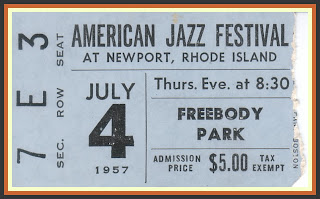


 In the late 1950s, the drummer with the Basie Band was Sonny Payne. He played on all of the wonderful charts that composer-arranger Neal Hefti was then writing for the band, including providing the marvelous brushwork on “Cute,” which became one of his drum features. Sonny was also on the Basie Band the night I heard them, but he gave way to Jo Jones and several other illustrious alumni of the band during a portion of the Sunday, July 7th concert at Newport, including Lester Young [whom I later found out was nicknamed ‘The Pres,’ short for The President of the Tenor Saxophone’].

 And what marvelously varied timbres they were! At the top was Basie's piano, which, though most often celebrated for its raindrop qualities, attained its relaxed drive from a skillful pitting of loose right-hand figures against heavy left-hand chords. On the next rung came Greene, a peerless rhythm guitarist, whose Prussian beat, guidepost chords, and Aeolian harp delicacy formed a transparent but unbreakable net beneath Basie. Page, who had a generous tone on the bass and a bushy way of hitting his notes, gave the group much of its resonance, which was either echoed by Jones's foot pedal and snare or diluted by his cymbal work.
 Jones's style, which has not changed appreciably in the past twenty-five years, except for some sporadic, and pardonable, middle-aged heaviness, is elegant and subtle. As an accompanist, he provides a cushion of air for his associates to ride on. Primarily, this is achieved by his high-hat technique. His oarlocks muffled, he avoids the deliberate chunt chunt-chunt effect of most drummers by never allowing the sound of his stick striking the cymbals to be audible, and instead of ceaselessly clapping his cymbals shut on the traditionally accented beats he frequently keeps them open for several beats, producing a shooshing, drifting-downstream quality.
 Jones is the embodiment of his own playing. A handsome, partly bald man whose physique resembles a tightly packed cigar and who moves in a quick, restless way, he smiles continually when he is at work, in a radiant, everything-is-fine-at-home fashion. Although he sits very still behind his drums (remember the demonic posturing of Gene Krupa?), his hands, attached to waving undersea arms, flicker about his set and his head snaps disdainfully from side to side, like a flamenco dancer's.
 Three of Jones's recent efforts - "The Jo Jones Special" (Vanguard), "Jo Jones Trio" (Everest), and "Jo Jones Plus Two" (Vanguard) - are sufficient samplers of his work. The first record is valuable largely for two takes of "Shoe Shine Boy," in which the old Basie rhythm section is reassembled, along with Emmett Berry, Lucky Thompson, and Benny Green. (Nat Pierce is on piano in four of the five other numbers, and for the last there is an entirely different group, composed of - among others - Pete Johnson, Lawrence Brown, and Buddy Tate.) The two versions are done at medium-up tempos, and are just about equal in quality. Thompson and Berry are in commendable form, but the rhythm section is priceless. Listen, in the first take, to the way Jones switches from joyous high-hat work behind Basie's solo to plunging, out-in-the-open patterns on his ride cymbal when the first horn enters; to Basie's down-the-mountainside left hand near the end of Thompson's first chorus; and to Jones's four-bar break on his snare drum at the close of the number, done with sharply uneven dynamics that make the prominent beats split the air. There is also a rendition of "Caravan," by the alternate group, in which Jones takes a tidy solo, complete with mallets on the tom-toms, bands on the tom-toms (here, a plopping sound like that achieved by hooking a finger into one's mouth, closing the lips, and drawing the finger abruptly out), and oil-and-water patterns on the snare with sticks.


 As vaudeville, carnivals, circuses, and other traveling shows felt the effect of talking pictures, radio, and recordings, it became apparent to Jones that the future was elsewhere. Because of the change in the entertainment business and the response of people to it, Jones became increasingly involved with drums and the performance of music with bands.
 [Quoting drummer Cliff Leeman]: Jo was sitting up there above the band, smiling and cooking. The band was on fire. Basie had found the recipe and Jo was a key part of it.
 “’The All-American Rhythm Section’ of Basie, Page, Green, and Jones had its own recipe. Relaxing, being natural, responding consonantly and with feeling to the music-all of this gave the section distinction. The section blended flow and interaction, flexibility and freedom, bringing to the Basie music a lightness and a provoking sense of pulsation that carried one along.
 Jo found it difficult to view Basie in a mechanical wheel chair. He only wanted to remember the glory years when everything was in a good groove.” [p. 149]
 LOUIE BELLSON [drummer, composer-arranger, big band leader]: “ As Buddy Rich said – and I agree – if you have to choose one guy it would be Jo Jones. When he came out with the Basie Band, it was if we had been waiting for him. Drummers listened and said: ‘Yeah, that’s where it is. That’s the way a drummer should sound.’ Jo brought fluidity – a musical, legato feeling – to drumming. He also showed us how to set up a band for the finale – the shout chorus. When he played that four bars it was like saying, “Here it is!”
 MEL LEWIS [drummer, co-leader of the Thad Jones Mel Lewis Orchestra later to become the Mel Lewis Jazz Orchestra, both forerunners of the current Village Vanguard Jazz Orchestra]: “Of course, Jo played the high-hat for Pres. But he did something else for him … and only for him. He did what he called his ‘ding, ding-a-ding’ on a small, heavy cymbal sitting on a spring holder that was mounted very low on the right side of the bass drum. It had a sound that carried and surrounded Pres.
 His rhythm was light and natural. It was there, easy to feel. It got you going. See, it wasn’t ‘right to it, right to it, right to it,’ you understand? It was somewhere between tight and loose. KC rhythm might seem straightforward. But it’s really sophisticated and subtle.”
 BOB BLUMENTHAL [Jazz writer and historian]: “To put Jo Jones in perspective, how many others in jazz history, both epitomized their own era and made essential contributions to the next?”
 The group performs six tunes including a measured, slow take on “Goin’ to Chicago Blues and toe-tapping versions of “Dark Eyes” and “Old Man River.”